Save the Merchant’s House
14 Years Fighting Development Next Door!
SAVE the Merchant’s House!
In January 2026, the developer applied to the Landmarks Preservation Commission for a NEW commercial building (their third proposed design) next door.
The proposed building is not only taller than the previous design, but also adds more bulk. All of which heightens the risk of irreparable damage and the real possibility of collapse!
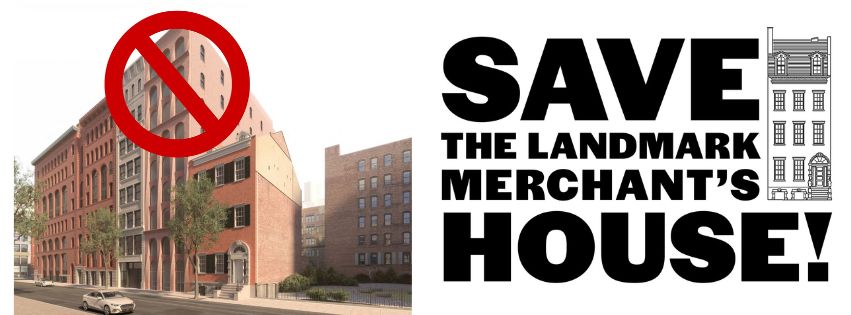
At LPC’s Public Hearing on Tuesday, March 17, our lawyers, engineers, staff, and scores of individuals testified against the project, in person and on Zoom. The LPC took no action.
LPC held a Public Meeting on September 29 where the developer re-iterated the architectural plans of the proposed eight-story 107 ft-tall building. The Commissioners discussed the appropriateness of its design and did not mention the threat of irreparable damage to our 1832 Landmark building. The public was not allowed to testify.
At the NEXT Public Meeting, the LPC’s consulting engineer, Don Friedman, will present his findings.
With Your HELP, We Will Prevail!
- SEND a LETTER to Mayor Mamdani to demand he SAVE the Merchant’s House!
Our easy-peasy form letter takes just 30 seconds to send. - SEND a LETTER to the Mayor and the LPC to demand they SAVE the Merchant’s House!
- SPREAD the Word! Ask your friends and colleagues to help. Post on Instagram, Facebook, X. And tag us @merchantshouse!
The 1832 Merchant’s House is indisputably one of the City’s most significant and beloved cultural and architectural landmarks — the only family home preserved intact with its original furnishings from the 19th century. It is also the only intact site of the Underground Railroad in Manhattan open to the public. Three years of extensive research has led to a remarkable conclusion: the 1832 Merchant’s House was built by its owner, abolitionist Joseph Brewster, to include a secret passageway intended to harbor freedom-seekers.
More Ways to Help!
- DONATE to the Legal Fund
- JOIN our email list for updates and calls to action!
The LPC Has a History of Betraying Our City’s Landmarks
As you may remember, in December 2023 the Landmarks Preservation Commission approved plans for another building (the developer’s second proposed design, at 8 stories) next door. They also instructed the developers to conduct a study of our landmark interior plaster. The developers never did; instead, they have filed new plans for a taller, bulkier building.
In recent years, the city’s LPC has catered to developers’ interests; 16 historic sites and landmarked buildings have been destroyed or damaged under their watch. If the Merchant’s House – the very first building designated a landmark in Manhattan, in 1965 – is at risk, no historic building is safe.
Since 2012, the Merchant’s House has been fighting to protect our 1832 landmark building from construction next door, to the west, at 27 East 4th Street. Currently it is a one-story garage.
Preservation architects and engineers have analyzed the proposed plans and determined that irreversible damage to the Merchant’s House is guaranteed. The worst case scenario is very possible: damage to the museum could be catastrophic (i.e., complete collapse).
At particular risk is our original – and landmarked – 19th century ornate decorative plaster work (considered the finest surviving from the period) as well as the plaster walls and ceilings. The original, 1832 plaster is extremely fragile. Vibrations from construction next door could cause it literally to come crumbling down.
At the LPC meeting on December 12, 2023, when asked, the developer’s engineers admitted that they have no data about what standards are appropriate when dealing with historic decorative plaster. Thus, approval is contingent upon the developer hiring a plaster expert (of their choosing!). The commissioners appeared to have had no knowledge of the plaster study we undertook in 2014.
The LPC also mandated that certain protocols relating to vibration monitoring be established. As we know from experience, even the most state-of-the-art vibration monitoring systems only announce when the vibration limit has been reached. The damage will have already begun.
To date, we have spent more than $1 million on legal and engineering fees, funds that could – and should – have gone to fulfilling our mission: preserving our landmark building, caring for our original collections, and educating the public.
If the construction next door is allowed to proceed, the Merchant’s House will be forced to close its doors to the public for at least two years to safeguard the collection and secure the building. The estimated cost is $4.1 million.


