Joseph Brewster
| … |
Portrait of Joseph Brewster, 1787-1851 |
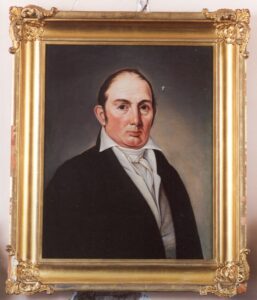
Joseph Brewster (1787–1851), a fervent abolitionist deeply involved in anti-slavery networks and activities, designed and built the Merchant’s House in 1832 as a home for himself and his wife, Susannah Merritt Brewster (1784-1859).
Brewster included a hidden passageway concealed beneath a built-in chest of drawers in the construction of his home. The narrow shaft, which descends from the second floor to the ground floor, has no known domestic or structural purpose, other than to harbor self-emancipators on their way to freedom.
Brewster sought and found his fortune in New York City, selling beaver hats.
|
… |
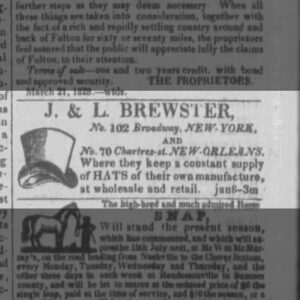 Advertisement for Brewster hats, Republican Banner, Nashville, TN, March 29, 1828 |
Joseph Brewster was born in Preston, CT, in 1787. He apprenticed as a hatter and set up shop in Lower Manhattan with his brother Lemuel, in 1813. The J & L Brewster Company specialized in men’s beaver hats, fashionable at the time and a symbol of wealth and respectability. By 1818, they had two shops on lower Broadway and Brewster hats were advertised and sold across the country.Brewster joined and quickly rose to leadership positions in professional societies, including the Society of Hatters and the Society of Mechanics and Tradesmen.
Swept up in the religious fervor of the Second Great Awakening, Brewster became a devout evangelical and avid social reformer.
In the 1820s, Brewster underwent a profound religious conversion and joined a network of reform-minded Protestant Evangelicals who believed individuals—and the nation—could be morally transformed. Brewster dedicated his time, and fortune, campaigning for temperance and the abolition of slavery. By the 1830s, abolition became the most pressing moral issue for evangelicals like Brewster.
Brewster was known to put temperance leaflets, or “tracts,” like these in the hats he sold. As a leader of the American Tract Society, Brewster received a large number of tracts of his choosing every year. Where better to put them!
By the 1830s abolition became the most pressing social reform movement, as slavery was considered both a moral outrage and an obstacle to spreading the gospel. Anti-slavery work, however, was still seen as radical.
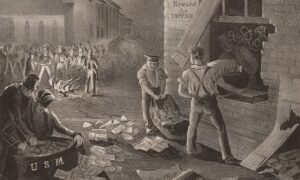
“New Method of Assorting the Mail, as Practiced by Southern Slave-Holders,” c. 1835
This political cartoon depicts a pro-slavery mob burning abolition tracts in an 1835 raid on the post office in Charleston, South Carolina.
Josph Brewster’s commitment to abolition is evidenced in all aspects of his life: religion, family, and business.
Brewster played a prominent role in founding and leading three anti-slavery churches, between 1826 and his death in 1851.
As a church elder, Brewster was integral in the creation, doctrine, and goals of the church, including selecting ministers sympathetic to the cause. At Brainerd Church, on Rivington Street, Brewster designed and built both the church and the houses on either side. He served as President of the Board of Trustees and authorized the construction of a false floor in the upper level of the church. Brainerd Church was integrated, with records that did not differentiate congregants by skin color, unlike others of the period. Brewster sold the Merchant’s House in order to move closer to this church.
The Rev. Asa Dodge Smith, selected by Brewster and the other elders to lead Brainerd Church, was well known for his abolitionist beliefs. Rev. Smith delivered Brewster’s funeral sermon, titled “The Guileless Israelite.” In his eulogy, he described Brewster as especially known as a generous, caring person to whom one could go for help, financial or practical – in spite of his own personal circumstances.
“It was affecting, at the funeral, to see with what emotion some of the poorer members of the church took their last look at that countenance, by the kindly radiance of which they had so often been cheered and comforted.”
Joseph Brewster signed two anti-slavery petitions – in 1831 and 1836 – making him one of very few activists willing to make public his name and connection to the abolitionist movement.
-
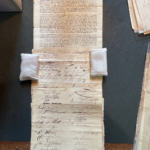
- 1836 petition to end slavery in the District of Columbia.
-
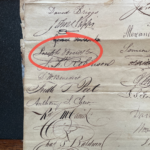
- Joseph Brewster’s signature
Signing a petition was a courageous act at the time, marking the signer as an outlier in pro-slavery New York. Slavery was such a controversial topic in the 1830s that it was banned from discourse in the United States Congress in 1836. Spurred on by the advocacy of former president John Quincy Adams, who championed the Constitutional right to petition, i.e, debate issues, activists like Brewster signed petitions to be carried onto the House floor, forcing the discussion of emancipation.
Even small acts can carry great significance: Frederick Douglass, remembering an 1831 petition like this one wrote in his memoirs:
“I often found myself regretting my own existence, and wishing myself dead; and but for the hope of being free, I have no doubt but that I should have killed myself, or done something for which I should have been killed. While in this state of mind, I was eager to hear any one speak of slavery. I was a ready listener…. After a patient waiting, I got one of our city papers, containing an account of the number of petitions from the north, praying for the abolition of slavery in the District of Columbia, and of the slave trade between the States. From this time I understood the words abolition and abolitionist, and always drew near when that word was spoken, expecting to bear something of importance to myself and fellow-slaves. The light broke in upon me by degrees.”


